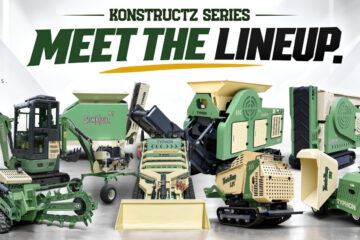
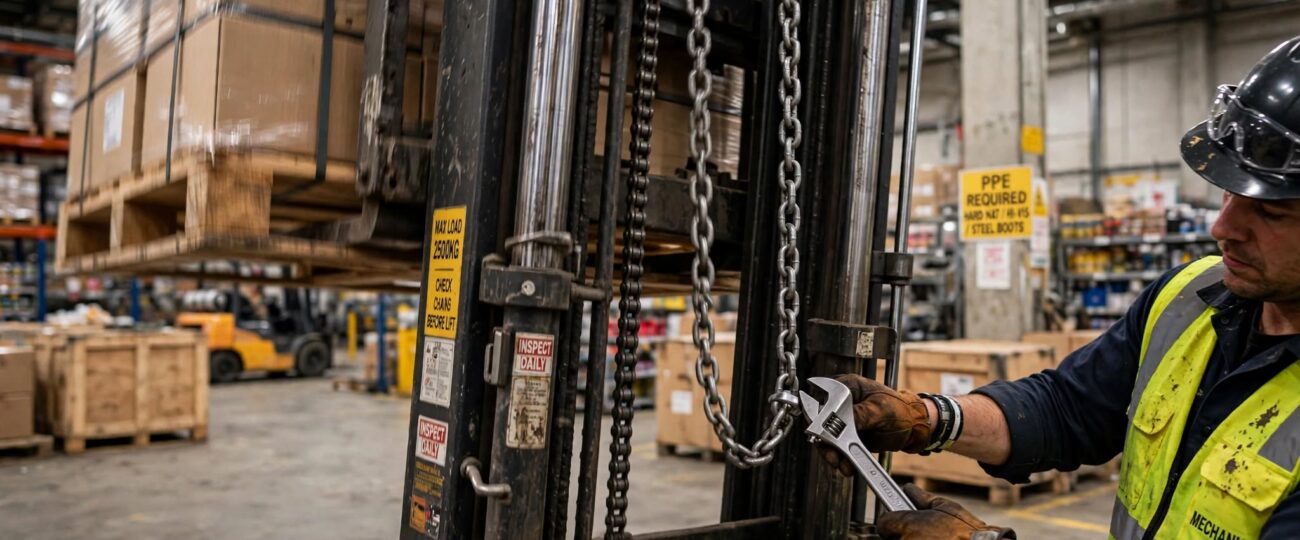

Your forklift carriage shakes and you feel it through the whole mast. You lift a pallet. The carriage vibrates. The load wobbles. The forks tremble. You slow down. You worry about the load falling. You worry about damage. You worry about safety. While upgrading your fleet might be an option—like when TYPHON Machinery introduces Konstructz series—maintaining your current equipment is crucial.
A forklift carriage shakes because the lift chains are uneven. One chain is tighter than the other. The tilt creates vibration. The vibration creates shake.
This post solves your problem. One chain fix stops the wobble. The fix takes minutes. The fix costs nothing. The fix saves your load and your machine. You learn why the carriage shakes, the chain adjustment procedure, and how to prevent carriage shake so you can lift loads with confidence.
☰ Table of Contents
The forklift carriage rides on the mast rails. Two lift chains raise it. The chains connect to the carriage corners. The chains pass over sheaves at the top of the mast and anchor at the mast base.
Both chains must have equal tension. Equal tension keeps the carriage level. Equal tension keeps the carriage smooth. Equal tension prevents shake.
A forklift carriage shakes when the chains are uneven. One chain stretches more than the other. The stretched chain allows the carriage to tilt. The tilt creates vibration.
Chains stretch for several reasons. Heavy loads stretch chains. Frequent use stretches chains. Poor lubrication stretches chains. Worn sheaves stretch chains. Loose anchor bolts stretch chains. Your forklift carriage shakes when one chain is longer. The longer chain has slack. The slack allows carriage movement. The movement creates shake.
- Worn chain rollers: The rollers ride on the mast rails. Worn rollers create uneven movement, causing vibration.
- Bent mast rails: The rails guide the carriage. Bent rails create binding, which creates vibration.
- Loose carriage bearings: The bearings guide the carriage on the rails. Loose bearings allow movement, causing shake.
The chain fix equalizes chain tension. Equal tension stops the shake. The fix takes 10 minutes. The fix requires one wrench.
Tools you need: One wrench for the chain anchor bolts. A tape measure. Your operator manual for chain tension specification.
- Park the forklift on level ground. Lower the forks to the ground. Shut off the engine. Lock out the machine. Engage the parking brake.
- Raise the mast to vertical position. The mast must stand straight. This position gives access to the chain anchors.
- Locate the chain anchor bolts at the top of the mast. Each chain has an anchor bolt. The bolts hold the chain ends.
- Measure both chains. Use your tape measure. Measure from the anchor bolt to the first chain roller. Record both measurements.
- Compare the measurements. One chain is longer. The longer chain has slack. If your forklift carriage shakes, this slack is often the culprit.
- Loosen the lock nut on the longer chain anchor. Turn the adjustment nut clockwise. This shortens the chain. Turn one quarter turn at a time.
- Tighten the lock nut. Measure both chains again. Both measurements must match. Equal length means equal tension.
- Test the lift. Raise the forks to full height. Watch the carriage. The issue where your forklift carriage shakes should stop. The carriage should rise smoothly.
Test under load. Lift a typical pallet. Raise it to full height. Lower it slowly. Watch the carriage. The shake should be gone.
Ignoring carriage shake causes severe problems.
Consequences of Shake
- Load instability: The load falls, breaks, or injures workers.
- Fork damage: The shaking load bends the forks ($500 replacement).
- Mast damage: The shaking carriage wears the mast rails unevenly ($2,000 replacement).
- Chain damage: Uneven chains wear faster and can break. A dropped carriage is fatal.
- Operator fatigue: Vibration tires the operator faster, leading to mistakes.
Your forklift carriage shakes and you face all these problems. The chain fix prevents every problem.
Chain tension directly affects carriage stability. Equal tension stops shake. Uneven tension causes shake.
| Tension Difference | Probability of Shake During Lifts |
|---|---|
| 0% (Equal Tension) | 5% |
| 10% Tension Difference | 60% |
| 20% Tension Difference | 95% |
A forklift carriage shakes when tension is uneven. Even a small difference causes noticeable shake.
Chain life also depends on tension. Equal tension gives 5000 hours of chain life. Uneven tension gives 2000 hours of chain life. The difference is 3000 hours.
Chain replacement costs 800 dollars per set. Over 5000 hours, uneven tension costs 800 dollars extra. Equal tension saves 800 dollars. Carriage bearing life improves with equal tension. Equal tension gives 4000 hours. Uneven tension gives 2000 hours. Bearing replacement costs 300 dollars.
When your forklift carriage shakes, the costs add up. The chain fix costs nothing. The chain fix saves money.
The chain fix solves most shake problems. Some cases have different causes. Check these if the chain fix does not work.
- Worn chain rollers: The rollers ride on the mast rails. Worn rollers create vibration. Your forklift carriage shakes with worn rollers. Replace the rollers.
- Bent mast rails: The rails guide the carriage. Bent rails cause binding. Binding causes vibration. Straighten or replace the rails.
- Loose carriage bearings: The bearings guide the carriage. Loose bearings allow movement. Movement causes shake. Tighten or replace the bearings.
- Worn chain sheaves: The sheaves guide the chains at the top. Worn sheaves cause chain skip. Chain skip causes vibration. Replace the sheaves.
- Dirty mast rails: Dirt on the rails causes binding. Binding causes vibration. Clean the rails weekly. Lubricate the rails.
- Loose anchor bolts: Loose bolts allow chain movement. Movement causes shake. Tighten all anchor bolts.
Your forklift carriage shakes when any of these problems exist. Check each component.
Prevention stops shake before it starts. Use these actions.
- Check chain tension weekly. Measure both chains. Adjust if uneven. This takes 5 minutes.
- Lubricate chains weekly. Use chain lubricant. Apply to both chains. Wipe excess lubricant.
- Clean mast rails weekly. Wipe dirt from the rails. Dirt causes binding. Binding causes shake.
- Check chain rollers monthly. Look for flat spots. Look for cracks. Replace worn rollers.
- Check carriage bearings monthly. Look for play. Look for damage. Tighten or replace worn bearings.
- Check anchor bolts monthly. Tighten loose bolts. Loose bolts cause chain slack.
- Inspect the mast for damage monthly. Look for bent rails. Look for cracks. Repair damage early.
These prevention actions take 15 minutes weekly. They save thousands of dollars in repairs. They keep the forklift safe.
Ignoring shake costs you money.
Costs of Ignoring Shake
- Load damage: Replacement costs $500 per incident.
- Fork damage: Bent forks cost $500 to replace.
- Mast damage: Worn rails cost $2,000 to replace.
- Chain damage: Broken chains cost $800 to replace.
- Downtime: Each downtime hour costs $200.
The 10-Minute Fix
- Adjustment Cost: $0.
- Saves Cargo: Prevents dropped pallets and product loss.
- Safety: Eliminates injury risks that exceed $10,000.
Your forklift carriage shakes and you face all these costs. The chain fix costs nothing. The chain fix prevents every cost.
Watch for these signs. They mean your forklift carriage shakes and needs immediate action.
- Visible carriage tilt: The carriage sits crooked. Stop work. Check chains.
- Load slipping: The load slides on the forks. Stop work. Check chains.
- Chain slack: One chain hangs loose. Stop work. Adjust chains.
- Chain noise: The chains make grinding sounds. Stop work. Lubricate chains.
- Carriage binding: The carriage sticks during lift. Stop work. Clean rails.
- Fork vibration: The forks vibrate during lift. Stop work. Check chains.
Do not ignore these signs. A shaking forklift carriage leads to accidents. Fix problems early. Save lives.
The lift chain system raises the forklift carriage. Two chains connect to it, pass over sheaves, and anchor at the base. The hydraulic cylinder pushes the carriage up. The chains follow the carriage. The chains keep the carriage level.
Both chains must have equal tension. Equal tension keeps the carriage level. Equal tension prevents shake.
Your forklift carriage shakes when one chain is longer. The longer chain allows the carriage to tilt, creating vibration. The chain adjustment nut shortens the chain. Shortening one chain levels it. Smooth movement stops the shake.
You now know the one chain fix. You know the adjustment procedure. You know the prevention actions. You know the signs of trouble.
Check your chain tension today. Measure both chains. Adjust if uneven. The issue where your forklift carriage shakes will stop for good.
Share your experience in the comments. Have you ever noticed your forklift carriage shaking? How often do you check chain tension? What problems have you seen? Your story helps other operators.
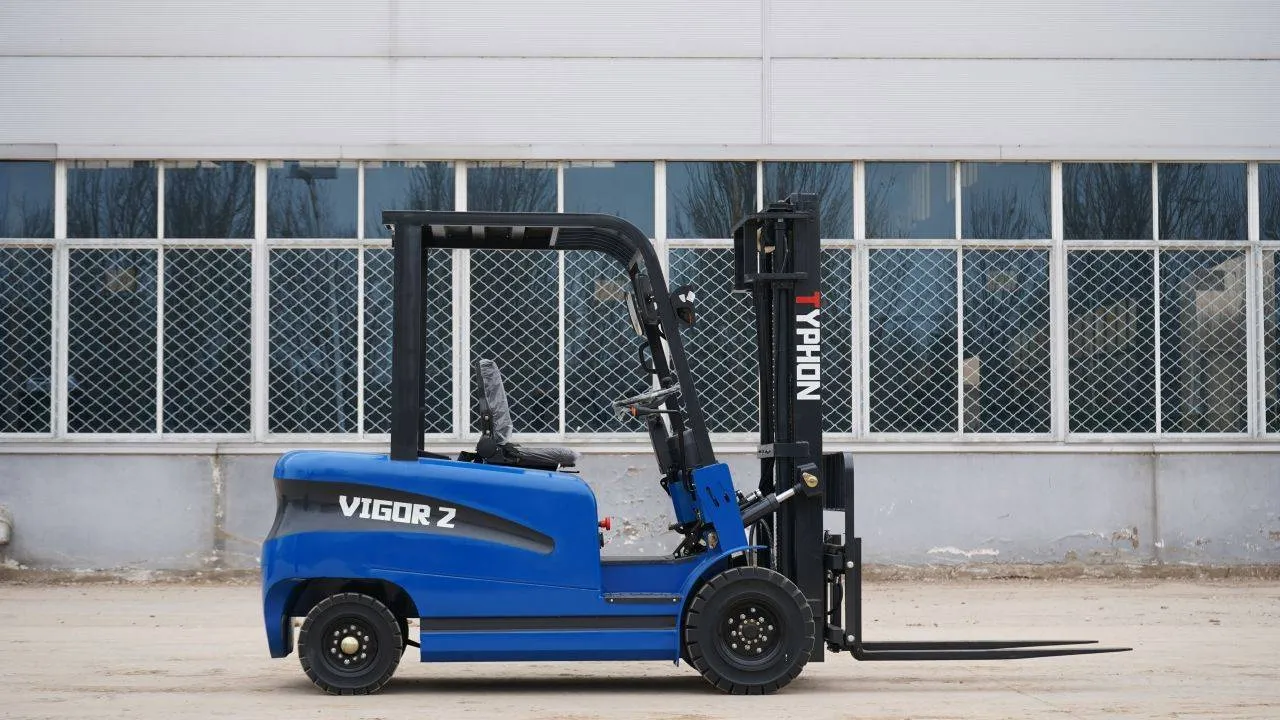
Looking for a modern, compact material handling solution? Experience perfectly balanced lifting with our new 2025 electric forklift.
View TYPHON Vigor 2 Compact Electric Forklift →