

Your mobile crane boom drops suddenly and you have a serious problem. You lift a load. The boom holds. Then the boom drops. The load falls. The load hits the ground. The load hits people. This is a fatal hazard. If you want to avoid other dangerous failures, learn how checking one grease type matters when your excavator swing bearing wears out.
A dropping boom means the hydraulic system lost pressure. The counterbalance valve holds the boom in position. When the valve fails, the boom drops.
Your mobile crane boom drops suddenly because the counterbalance valve is stuck, worn, or set wrong. This post solves your problem. One counterbalance valve check stops the fall. The check takes minutes. The check costs nothing. The check saves lives.
You learn why the boom drops. You learn the counterbalance valve check. You learn how to prevent sudden drops. You protect your crew and your load.
☰ Table of Contents
The counterbalance valve controls boom movement. The valve sits between the boom cylinder and the control valve. The valve holds pressure in the cylinder. The valve prevents the boom from dropping when the control lever is neutral.
Your mobile crane boom drops suddenly when the counterbalance valve fails. The valve fails for several reasons.
Causes of Valve Failure
- Stuck valve spool: Dirt blocks the spool inside the valve body. It cannot close, pressure leaks, and the boom drops.
- Worn valve spring: A worn spring loses tension. Pressure leaks. Your mobile crane boom drops suddenly with a worn spring.
- Broken valve seal: A broken seal allows oil to bypass. Pressure drops.
- Wrong valve setting: Opens the valve too early, causing a pressure drop.
- Contaminated oil: Dirt wears and blocks the valve. Your mobile crane boom drops suddenly with contaminated oil.
Low hydraulic oil reduces system pressure. The counterbalance valve cannot hold pressure. The boom drops.
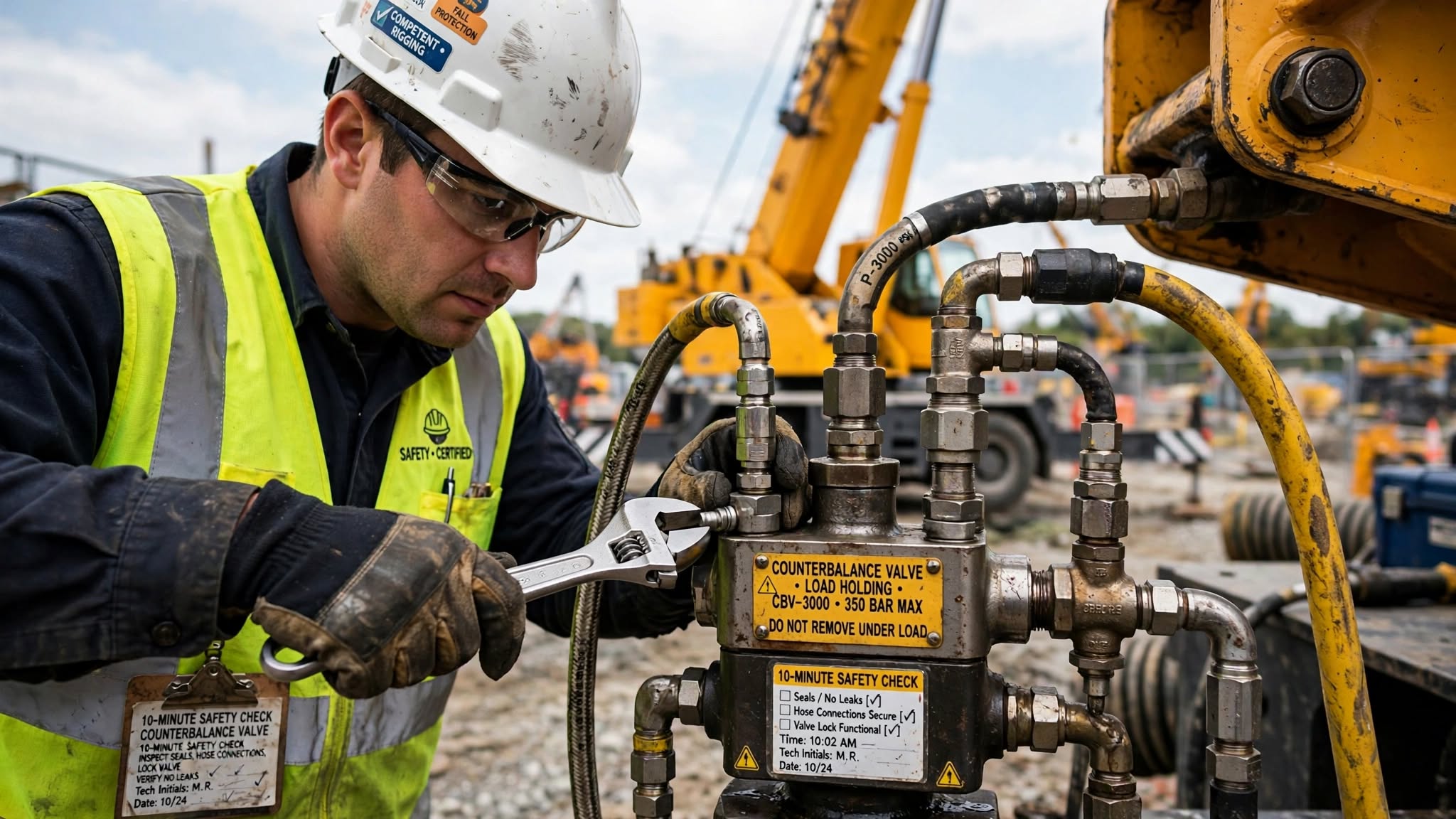
The counterbalance valve check confirms the valve holds pressure. The check takes 10 minutes. The check finds the problem.
Tools you need: A pressure gauge with a hose. A wrench for the valve cap. Clean rags. Your operator manual for valve specifications.
- Park safe: Park the mobile crane on level ground. Lower the boom to the ground. Shut off the engine. Lock out the machine.
- Locate valve: Locate the counterbalance valve on the boom cylinder. It sits on the cylinder barrel. It looks like a block with hoses attached.
- Connect gauge: Connect the pressure gauge to the test port on the counterbalance valve. Refer to your manual for the exact port location.
- Test pressure: Start the engine. Raise the boom slightly off the ground. Hold the control lever in neutral. Watch the pressure gauge. The pressure should hold steady. If the pressure drops, your mobile crane boom drops suddenly will happen.
- Inspect spool: Stop the engine. Lock out the machine. Remove the counterbalance valve cap. Inspect the valve spool. Look for dirt, wear, or scoring. Clean the spool with a rag. Do not use abrasive material.
- Check spring & seals: Check the valve spring for cracks or weakness. Replace the spring if worn. Check the valve seals for cracks or hardness. Replace the seals if worn.
- Reinstall & retest: Reinstall the valve. Tighten to specification. Start the engine. Raise the boom. Hold the control lever in neutral. Watch the gauge. The pressure should hold steady.
- Load test: Lift a typical load. Hold the load in position. Watch the boom. The issue where your mobile crane boom drops suddenly should stop. The boom should hold.
Ignoring a dropping boom causes disaster.
- Load drop: The load falls from height. It hits the ground, equipment, or workers. A falling load kills.
- Crane damage: The boom hits the ground. It bends and cracks. Boom replacement costs 50,000 dollars.
- Cylinder damage: The sudden drop damages the cylinder. The rod bends. Seals blow. Cylinder replacement costs 10,000 dollars.
- Structural damage: The sudden drop stresses the crane frame. The frame cracks. Frame repair costs 20,000 dollars.
Your mobile crane boom drops suddenly and you face these costs. The counterbalance valve check prevents every problem.
Counterbalance valve failure causes 40 percent of crane boom drops.
| Cause of Boom Drop | Percentage of Incidents |
|---|---|
| Stuck Spools | 25% |
| Worn Springs | 15% |
| Broken Seals | 10% |
| Wrong Settings | 10% |
Your mobile crane boom drops suddenly most often from a stuck spool. Dirt causes the spool to stick. Clean oil prevents sticking.
Accident data shows 60 percent of crane accidents involve load drops. Most load drops happen from boom failure. Most boom failures happen from counterbalance valve failure.
The counterbalance valve check takes 10 minutes. The check prevents accidents. The check saves lives.
The counterbalance valve check fixes most drop problems. Some cases have different causes. Check these if the valve check does not work.
- Worn boom cylinder seals: Seals hold pressure in the cylinder. Worn seals allow internal leakage. Your mobile crane boom drops suddenly with worn seals. Rebuild the cylinder.
- Damaged cylinder rod: A damaged rod damages the seals. Damaged seals leak. Pressure drops. Replace the rod.
- Loose hydraulic fittings: Loose fittings leak oil, reducing pressure. The boom drops. Tighten all fittings.
- Clogged hydraulic filter: A clogged filter restricts flow, reducing pressure. Your mobile crane boom drops suddenly with a clogged filter. Change the filter.
- Worn hydraulic pump: A worn pump creates low flow. Low flow means low pressure. Replace the pump.
- Failed control valve: A failed valve sends oil to the tank. Pressure drops and the boom drops. Replace the control valve.
Prevention stops boom drops before they start. Use these actions.
- Check the counterbalance valve monthly. Test the pressure holding. Clean the valve spool. Replace worn parts.
- Change hydraulic oil every 1000 hours. Old oil breaks down and cannot hold pressure. Your mobile crane boom drops suddenly with old oil.
- Change hydraulic filter with every oil change. A clean filter allows full flow. Full flow maintains pressure.
- Check hydraulic oil level daily. Low oil reduces pressure. Top up oil when needed.
- Inspect hydraulic hoses monthly. Look for cracks and leaks. Replace damaged hoses.
- Check cylinder seals monthly. Look for oil leaks around the cylinder. Replace worn seals.
- Test the boom holding function weekly. Raise the boom. Hold the load. Watch for drift. Drift means valve wear. Adjust or replace the valve.
These prevention actions take 15 minutes weekly. They save thousands of dollars in repairs. They save lives.
Ignoring a dropping boom costs lives. The human cost is immeasurable.
Financial & Repair Costs
- Accident fines exceed $100,000. Legal fees exceed $50,000.
- Settlement payments exceed $500,000. Insurance premiums increase.
- Boom replacement: $50,000. Cylinder replacement: $10,000. Frame repair: $20,000.
- Downtime: The crane stops working. Costs $500 per hour.
The 10-Minute Fix
- Valve Check: Costs nothing.
- Saves Components: Prevents $80,000+ in machine damage.
- Protects Lives: Eliminates the risk of catastrophic load drops.
Your mobile crane boom drops suddenly and you face these massive costs. The counterbalance valve check costs nothing and prevents every single cost.
Watch for these signs. They mean your mobile crane boom drops suddenly and needs immediate action.
- Boom drift: The boom moves when the control lever is neutral. Stop work. Check the valve.
- Boom noise: Grinding or clicking sounds from the boom. Stop work. Inspect the valve.
- Pressure loss: The pressure gauge shows dropping pressure. Stop work. Check the valve.
- Oil leaks: Oil leaks from the valve or cylinder. Stop work. Repair the leak.
- Slow boom response: The boom responds slowly to control input. Stop work.
- Load swing: The load swings without control input. Stop work. Check the valve.
Do not ignore these signs. A situation where your mobile crane boom drops suddenly leads to disaster. Fix problems early to save lives.
The counterbalance valve is a hydraulic valve. It sits between the cylinder and the control valve. It has a spool, a spring, and seals.
The spool moves inside the valve body. The spring pushes the spool closed. The spool closes the oil path. The oil stays in the cylinder. The boom holds position.
When the operator moves the control lever, pressure opens the spool. Oil flows to the cylinder. The boom moves.
When the operator returns the lever to neutral, pressure drops. The spring closes the spool. Oil stays in the cylinder. The boom holds.
Your mobile crane boom drops suddenly when the spool does not close. Dirt blocks the spool. A worn spring does not close the spool. Broken seals leak past the spool.
The counterbalance valve check confirms the spool closes. The check confirms the spring tension. The check confirms the seals hold. The check prevents boom drops.
You now know the one counterbalance valve check. You know the checking procedure. You know the prevention actions. You know the signs of trouble.
Check your counterbalance valve today. Test the pressure holding. Clean the valve. Replace worn parts. The problem where your mobile crane boom drops suddenly will stop.
Share your experience in the comments. What pressure does your boom hold? How often do you check the valve? What problems have you seen? Your story helps other operators.
Looking for a premium, heavy-duty excavator with advanced hydraulics and an enclosed cabin for maximum safety? Upgrade your fleet today.
View TYPHON Terror LXV 6.6 Ton Excavator →Heavy equipment operations and safety insights powered by TyphonMachinery.com