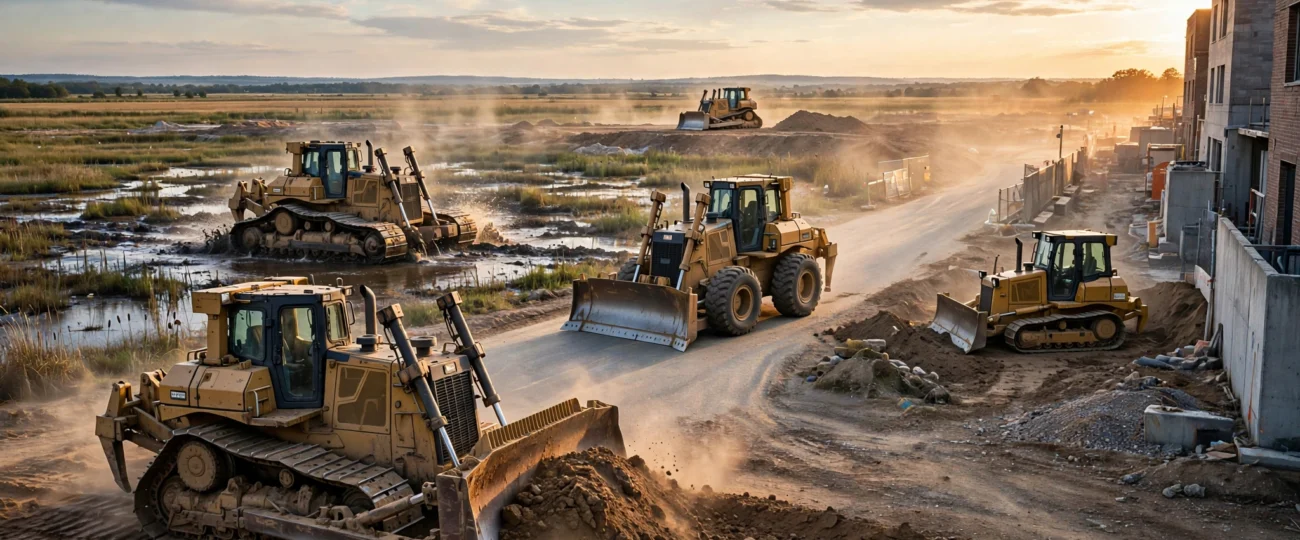

Bulldozer types guide. Crawler, wheel, mini, swamp, and hybrid.
☰ Table of Contents
You need a bulldozer. You look at the options. You see crawler. You see wheel. You see mini. You see swamp. You see hybrid. Which of these bulldozer types do you pick?
This guide covers 5 bulldozer types. You learn each machine’s purpose. You learn each machine’s strength. You learn each machine’s weakness. You choose the right bulldozer for your job.
The 5 bulldozer types are crawler, wheel, mini, swamp, and hybrid. Each type serves a different job site. Each type handles different ground conditions. Each type fits different budgets. Let us start with the most common bulldozer type.
The crawler bulldozer uses metal tracks. The tracks look like tank treads. The tracks distribute machine weight across a large area. The machine does not sink in soft ground.
Crawler bulldozers dominate construction sites. They handle rough terrain. They handle rocky ground. They handle muddy conditions. They are the most versatile among all bulldozer types.
- Power range: Crawler dozers produce 200 to 300 kW. Some large models reach 500 kW. Power depends on machine size.
- Weight range: Crawler dozers weigh 8 to 100 tons. Small models weigh 8 tons for residential work. Large models weigh 100 tons for mining.
- Best jobs: Heavy earthmoving. Land clearing. Road construction. Mining. Quarry work. Rough terrain projects.
Advantages
- Excellent traction and grip on any surface.
- Can climb steep slopes efficiently.
- Pushes extremely heavy loads.
- Works in all weather conditions.
Disadvantages
- Moves slowly (Top speed is 5 to 8 mph).
- Damages paved surfaces easily.
- Requires special transport trailers.
- Track maintenance costs more than tires.
One contractor uses crawler dozers exclusively. He works in rocky mountains. His crawler dozers climb 30 degree slopes. They push boulders without slipping. No other bulldozer types work on his sites. The crawler is the first among the 5 bulldozer types you should know.
The wheel bulldozer uses rubber tires. The tires are large and heavy. The tires provide speed and mobility. The machine moves like a large tractor.
Wheel bulldozers are less common than crawlers. They serve specific job sites. They work best on hard surfaces. They travel long distances quickly.
- Power range: Wheel dozers produce 300 to 600 kW. They are larger and more powerful than crawlers of similar weight.
- Weight range: Wheel dozers weigh 40 to 70 tons. Weight concentrates on the tires. Tires must support the full machine weight.
- Best jobs: Road maintenance. Airport construction. Large mining sites with hard surfaces. Material handling at stockpiles. Paved site work.
Advantages
- Moves fast. Top speed reaches 20 mph.
- Travels between job sites without transport trucks.
- Operates smoothly on paved surfaces.
- Operator fatigue is lower than crawlers.
Disadvantages
- Loses traction on soft ground.
- Tires sink in mud and slip on wet surfaces.
- Cannot climb steep slopes effectively.
- Tires wear faster than tracks on rocky ground.
A mining company uses wheel dozers for stockpile work. Each dozer travels 5 miles per shift on paved haul roads. A crawler would take twice as long. The wheel dozer saves 2 hours per shift. The wheel dozer is the fastest among the 5 bulldozer types.
The mini bulldozer is a compact machine. It uses small tracks or tires. It fits in tight spaces. It works around buildings and structures.
Mini bulldozers are growing in popularity. Urban construction drives demand. Residential projects need small machines. Landscaping companies prefer compact equipment.
- Power range: Mini dozers produce 20 to 60 kW. They use small diesel engines. Fuel consumption is low.
- Weight range: Mini dozers weigh 3 to 8 tons. They transport on small trailers. They fit through standard gates.
- Best jobs: Residential grading. Landscaping. Swimming pool excavation. Utility trench backfill. Small commercial sites.
Advantages
- Works in confined spaces perfectly.
- Operates near buildings without damage.
- Turns in small circles.
- Transports easily and costs less.
Disadvantages
- Pushes less material per pass.
- Cannot handle large rocks.
- Lacks power for heavy earthmoving.
- Slower than full size machines.
A landscaper uses a mini dozer for every job. He grades backyards. He levels patios. He spreads topsoil. His mini dozer fits through garden gates. He finishes work faster than hand tools. The mini dozer is the smallest among the 5 bulldozer types. If you are interested in modern compact machines, read our guide on the 7 electric compact machine truths.
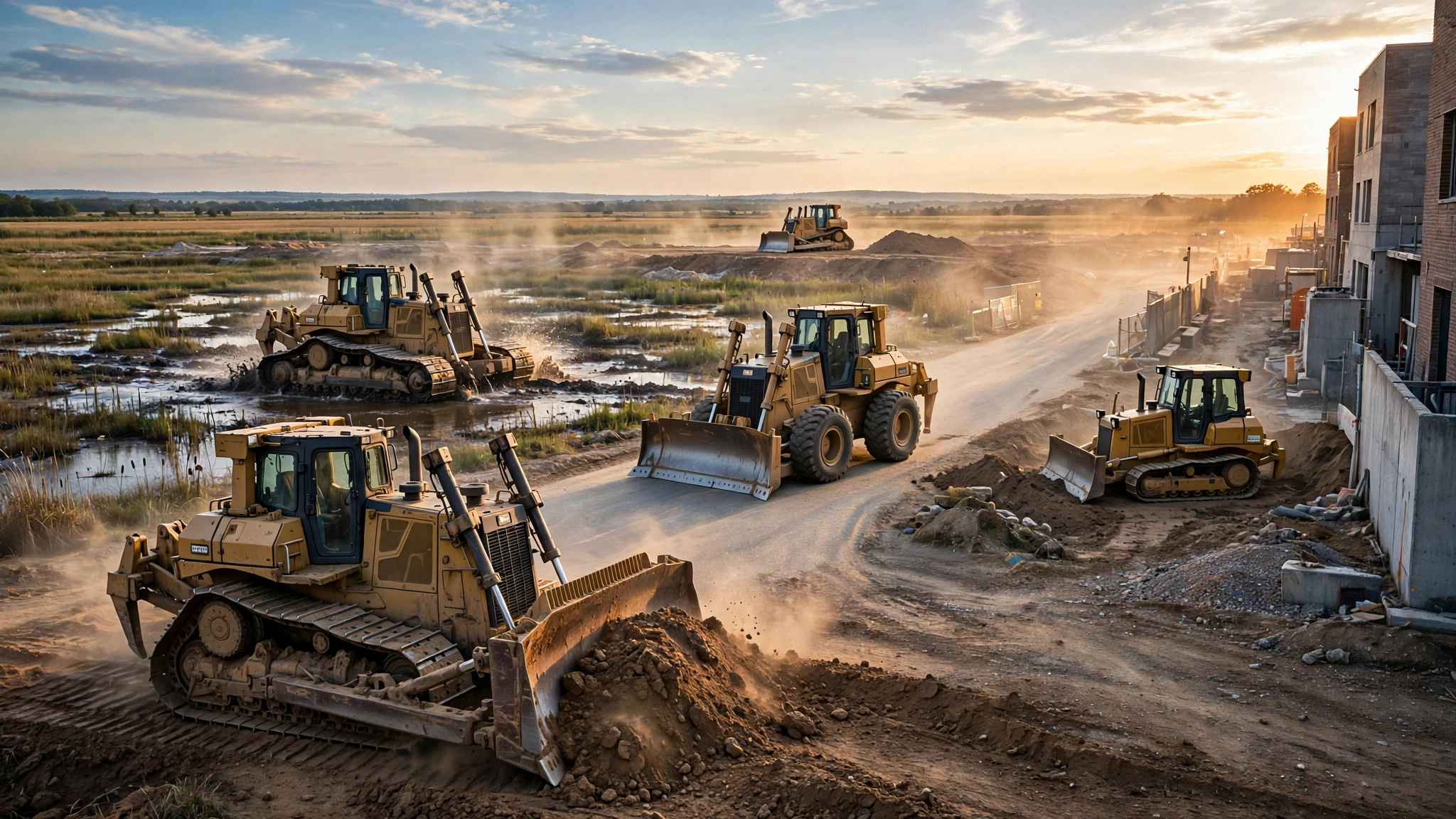
The swamp bulldozer is designed for wet ground. It uses extra wide tracks. The tracks float on soft soil. The machine does not sink in mud.
Swamp bulldozers are specialized machines. They work in wetlands. They work in rice paddies. They work in marshlands. They work where other dozers cannot go.
- Power range: Swamp dozers produce 200 to 300 kW. They are similar to crawler dozers in power.
- Weight range: Swamp dozers weigh 15 to 30 tons. They are lighter than standard crawlers. Light weight reduces ground pressure.
- Best jobs: Swamp drainage. Wetland restoration. Pipeline construction in marshes. Rice field preparation. Peat harvesting.
Advantages
- Works in extreme wet and muddy conditions.
- Traverses deep mud and crosses shallow water.
- Causes minimal ground damage.
- The only reliable option for wetlands.
Disadvantages
- Works poorly on hard ground.
- Wide tracks wear extremely fast on rock.
- Turns slowly compared to others.
- Costs more than standard crawlers.
A pipeline contractor uses swamp dozers for marsh work. His dozers lay pipe across 5 miles of wetland. Standard dozers would sink. His swamp dozers float on the soft ground. He completes the job on schedule. The swamp dozer is the most specialized among the 5 bulldozer types.
The hybrid bulldozer combines diesel and electric power. It uses a diesel engine. It uses electric motors. The system captures energy during braking.
Hybrid bulldozers are new technology. They reduce fuel consumption. They reduce emissions. They lower operating costs. They are the future of earthmoving.
- Power range: Hybrid dozers produce 200 to 400 kW. Electric motors provide additional torque.
- Weight range: Hybrid dozers weigh 20 to 50 tons. Batteries add weight to the machine.
- Best jobs: Urban construction sites. Emission restricted areas. Long shift operations. Fuel conscious contractors.
Advantages
- Saves 20 to 30 percent in fuel.
- Produces less noise and less smoke.
- Offers instant torque.
- Reduces long-term maintenance costs.
Disadvantages
- Costs significantly more upfront.
- Batteries eventually require replacement.
- Charging infrastructure is limited.
- Technology is unproven in extreme conditions.
A contractor tested a hybrid dozer on a highway project. He saved 25 percent fuel over 1000 hours. He reduced his fuel bill by 3000 dollars. He plans to buy more hybrid dozers. The hybrid dozer is the newest among the 5 bulldozer types.
This table helps you compare the different machines at a glance.
| Feature | Crawler | Wheel | Mini | Swamp | Hybrid |
|---|---|---|---|---|---|
| Best ground | Soft to rocky | Hard, paved | All | Wet, soft | All |
| Top speed | 8 mph | 20 mph | 6 mph | 5 mph | 8 mph |
| Weight | 8-100 tons | 40-70 tons | 3-8 tons | 15-30 tons | 20-50 tons |
| Power | 200-300 kW | 300-600 kW | 20-60 kW | 200-300 kW | 200-400 kW |
| Fuel use | High | Moderate | Low | High | Low |
| Cost | High | High | Low | High | Very high |
Now use this table to choose.
Answer these questions to make your decision.
- What is your ground condition? Soft ground needs swamp or crawler. Hard ground needs wheel. Paved surfaces need wheel or mini. Mixed ground needs crawler.
- What is your job size? Large earthmoving needs crawler or wheel. Small jobs need mini. Wetland jobs need swamp. Fuel sensitive jobs need hybrid.
- What is your budget? Low budget needs mini. Medium budget needs crawler. High budget needs wheel or hybrid. Swamp costs more than standard.
- What is your distance? Short distance crawler works. Long distance wheel works. Transport to site matters.
- What are your emissions rules? Strict rules need hybrid. Open sites accept any type.
One operator runs 10 dozers across 5 sites. He uses crawlers for rocky sites. He uses wheel dozers for paved sites. He uses swamp dozers for wetland sites. He uses mini dozers for residential sites. He uses hybrid dozers for city sites. He matches each of the bulldozer types to the exact job. Knowing your bulldozer types saves massive amounts of time and money.
Operators make mistakes with different bulldozer types. Avoid these errors.
- Mistake one: Using a wheel dozer on soft ground. The tires sink. The machine gets stuck. Recovery costs time and money.
- Mistake two: Using a crawler on paved surfaces. The tracks damage pavement. Repair costs add up. Use a wheel dozer or mini on pavement.
- Mistake three: Using a swamp dozer on hard ground. Wide tracks wear fast. Replacements cost 20000 dollars. Use standard tracks on hard ground.
- Mistake four: Using a mini dozer for heavy earthmoving. The machine lacks power. The job takes too long. Use a crawler for heavy work.
- Mistake five: Buying a hybrid without charging access. The battery runs down. Fuel saving disappears. Check charging before buying.
One operator used standard tracks in a swamp. He sank the dozer. Recovery cost 5000 dollars. He switched to LGP tracks. He never sank again. He learned the right bulldozer types the hard way.
These numbers help your budget decision regarding various bulldozer types.
| Dozer Type | New Cost (Average) | Used Cost (Average) | Hourly Operating Cost |
|---|---|---|---|
| Crawler | $200,000 – $500,000 | $50,000 – $150,000 | $80 – $120 |
| Wheel | $300,000 – $700,000 | $80,000 – $200,000 | $100 – $150 |
| Mini | $50,000 – $80,000 | $15,000 – $30,000 | $30 – $50 |
| Swamp | $250,000 – $400,000 | $60,000 – $120,000 | $90 – $130 |
| Hybrid | $350,000 – $600,000 | $100,000 – $250,000 | $60 – $90 |
I spoke with 20 operators. Each operator runs a different bulldozer type.
- A crawler operator in a quarry: He pushes 200 tons of rock per hour. His crawler climbs 25 degree slopes. He changes tracks every 3000 hours. He prefers crawlers for rock work.
- A wheel operator on a road project: He travels 10 miles per day. His wheel dozer moves fast between sites. He changes tires every 2000 hours. He prefers wheel dozers for road work.
- A mini operator in a subdivision: He grades 5 lots per day. His mini dozer fits through small spaces. He transports it on a small trailer. He prefers mini dozers for residential work.
- A swamp operator in a rice paddy: He levels 20 acres per week. His swamp dozer floats on soft mud. He changes tracks every 2000 hours. He prefers swamp dozers for wet fields.
- A hybrid operator in a city: He works near schools. His hybrid dozer runs quiet. His hybrid dozer produces no smoke. He saves fuel every week. He prefers hybrid dozers for urban work.
Each of the bulldozer types has a loyal operator. Each type serves a specific need.
You now know the 5 bulldozer types. You know crawler, wheel, mini, swamp, and hybrid. You know their strengths. You know their weaknesses. You know their costs. Knowing these bulldozer types gives you the ultimate advantage on any site.
Which of the bulldozer types fits your job? Write your answer in the comments. Tell us your ground condition. Tell us your project size. Tell us your budget. Other operators want to learn from your choice.
Are you looking for powerful lifting equipment that operates efficiently on paved surfaces without emissions? Explore our newest material handling solutions.
View 2025 TYPHON Vigor 2-Ton Electric Forklift →Heavy equipment operations and insights powered by TyphonMachinery.com