
☰ Table of Contents
- Why Couplers Become Loose
- The Safety Pin is Your Backup
- The One Safety Pin Check
- Different Coupler Types & Risks
- Training Prevents Failure
- Daily Inspection Routine
- Maintenance Prevents Wear
- Warning Signs of Coupler Failure
- Cost of Ignoring the Safety Check
- Engineering Controls
- Creating a Safety Culture
You change buckets quickly with a quick coupler. The system saves time. The system makes work faster. But the system creates serious risk. A loose coupler releases the attachment. A falling bucket crushes anyone below. Learning safety is just as critical as diagnosing errors; for example, knowing what to do when your electric forklift controller shows error code saves downtime and repair costs.
Your mini excavator quick coupler locks loose and you might not even realize it. This is a critical safety hazard. It demands attention before every work shift and after every attachment change.
This post covers the one safety pin check. The check takes seconds. The check costs nothing. The check prevents fatal accidents. You learn why couplers fail. You learn the exact safety pin check procedure. You learn how to prevent dropped attachments. You protect your crew and yourself.
Quick couplers allow fast attachment changes. They use hydraulic or mechanical locking systems. These systems grip the attachment pins. When the grip fails, the attachment falls.
Most coupler related accidents happen because operators fail to secure the safety pin. The locking mechanism is not fully engaged. The operator assumes the coupler is locked. The assumption is wrong.
Several factors contribute to coupler failure:
- Operator complacency: Changing attachments becomes routine. The operator skips the safety check. The primary lock fails.
- Poor working conditions: Rain, mud, and dust obscure the lock mechanism. The operator cannot see the pin and assumes it is in place.
- Inadequate training: The operator does not know the correct procedure or that the safety pin exists.
- Mechanical wear: The coupler hooks and locking pins wear down. The worn parts do not grip securely.
Your mini excavator quick coupler locks loose when any of these factors combine. The result is a dropped attachment. The result can be fatal.
The safety pin is a physical lock. It prevents the coupler from opening. It is your last line of defense.
Your mini excavator quick coupler locks loose when you skip the safety pin. The pin stops the coupler from releasing the attachment. Without the pin, the attachment can fall at any time.
Manual quick couplers are especially dangerous. They rely entirely on the operator to insert the pin. The pin is easy to forget. The pin is easy to lose. The pin is easy to misplace.
Hydraulic couplers also need the safety pin. Many hydraulic couplers have a backup pin. The pin engages if the hydraulic lock fails. The operator must still insert the pin manually. The safety pin is not optional. It is required. Your mini excavator quick coupler locks loose if you operate without the pin.
The safety pin check has four parts. Perform this check every time you change attachments. Perform this check before you start work each day.
- Part one (Visual inspection): Park the machine on level ground. Lower the attachment to the ground. Shut off the engine. Engage the hydraulic lock lever. Exit the cab. Look at the locking mechanism. Your mini excavator quick coupler locks loose if the safety pin is missing. Is it fully inserted? Does it move? Movement means the pin is not secure. Check the visual rod indicator to confirm engagement.
- Part two (The bump test): The bump test simulates work forces. Press the bucket against the ground. Apply moderate pressure. Try to shake the bucket using the joystick. Your mini excavator quick coupler locks loose if the bucket moves. Stop work and reattach it.
- Part three (Manual pin installation): For manual or semi-automatic couplers, insert the safety linchpin. The safety pin goes behind the rear spring-loaded hook. The hook cannot move. Store the safety pin on the machine to avoid losing it.
- Part four (Final confirmation): Return to the cab. Test the attachment. Lift it slightly off the ground. Swing it gently from side to side. Watch the coupler closely. Look for any play.
Your mini excavator quick coupler locks loose if you see movement at the coupler. Stop work immediately. Do not use the machine until the attachment is secured.
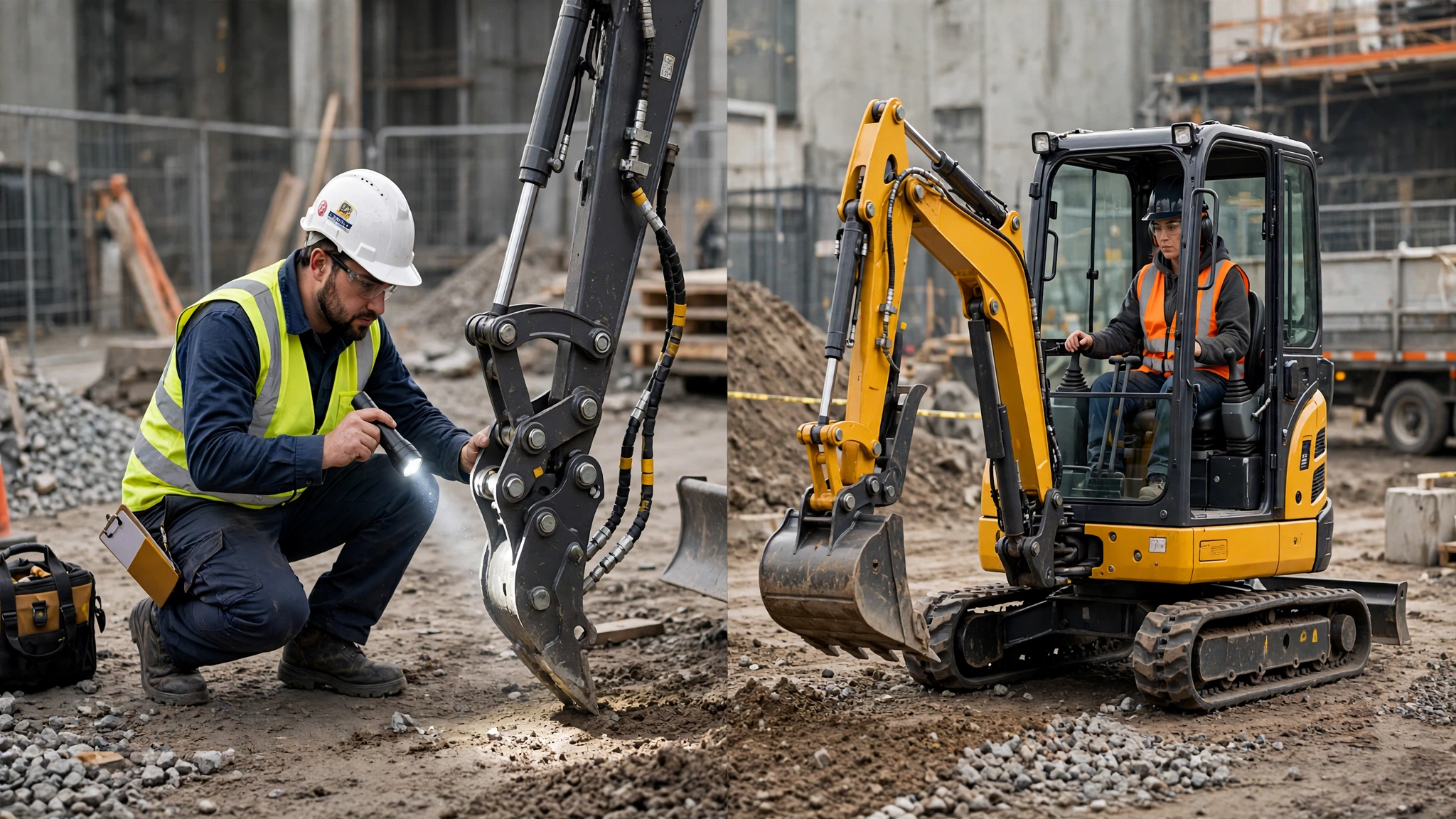
Your mini excavator quick coupler locks loose differently based on the coupler type.
Hydraulic & Semi-Automatic
- Hydraulic: A wedge moves into place via cab controls. Visual indicators show green (locked) or red (unlocked). Must still insert backup pin.
- Semi-automatic: Operator controls primary lock from cab but must insert the safety pin manually on the ground.
- Benefit: Forces the operator to leave the cab, inspect the coupler, and clear debris.
Manual Quick Hitches
- Uses a spring-loaded hook. Operator pulls a bar to compress the spring.
- Safety pin MUST be inserted behind the hook.
- Risk: Relying entirely on manual operation. Without the pin, the hook releases. Your mini excavator quick coupler locks loose and the bucket drops.
Do not trust the hydraulic lock alone. Your mini excavator quick coupler locks loose if the hydraulic system fails.
Your mini excavator quick coupler locks loose when operators lack training. Proper training is the most important prevention measure. A universal procedure does not exist.
- Visual inspection: How to check for wear, proper pin insertion, and identify blocking debris.
- Attachment engagement: Correct procedure and order of operations for attaching each tool type.
- Connection testing: How to perform the bump test and interpret movement.
- Daily inspection: Items to check before every shift and signs of impending failure.
Refresher training is also required. Operators become complacent over time. Regular training reinforces safe habits. Supervisors must enforce the safety check and discipline those who skip it.
Your mini excavator quick coupler locks loose when you skip daily inspections. Inspect the coupler before every shift. The inspection takes two minutes. It saves lives.
- Inspect the coupler visually for cracks, worn hooks, worn pins, and missing retaining clips.
- Check the safety pin. Is it present? Fully inserted? Locked? Replace damaged pins immediately.
- Check the attachment seating. Are both pins engaged without any gaps? Any gap means the attachment is not secure.
- Check the warning labels. Are they legible? They remind operators to check the pin.
- Clean debris from the coupler. Mud and dirt hide problems.
Your mini excavator quick coupler locks loose when the coupler is worn. Maintenance extends coupler life and prevents sudden failure.
| Interval | Maintenance Action |
|---|---|
| Daily | Perform visual inspection, clean debris, grease pivot points, check clips. |
| Every 50 Hours | Clean thoroughly, inspect wear surfaces, measure pin wear, re-grease. |
| Every 250 Hours | Remove pins for detailed inspection, check housing for cracks, replace worn components. |
| Every 500 Hours | Full inspection by a qualified mechanic. Test lock mechanism and pin fit. |
Keep maintenance records. Use the correct grease. Under-greasing causes rapid wear. Over-greasing attracts dirt, accelerating wear.
Watch for these warning signs. They mean your mini excavator quick coupler locks loose and is about to fail.
- Movement at the coupler: Any relative movement is abnormal. Stop work immediately.
- Inability to insert the pin: Means attachment is not seated correctly. Remove and reattach.
- Pin that falls out: The pin is loose and will not stay locked. Replace immediately.
- Visible wear on the hook: Hook is thinning or rounded and no longer grips. Replace the hook.
- Cracks in the housing: Coupler can break under load. Replace housing.
- Unusual noise: Grinding or clicking means internal wear. Inspect immediately.
Do not ignore these signs. A small problem becomes a big problem quickly. An attachment drop causes fatalities.
Ignoring the safety check costs lives. The human cost is immeasurable. Families lose loved ones. Workers lose colleagues.
Financial costs are measurable. Fines from regulatory agencies. Legal fees. Settlement payments. Increased insurance premiums. Productivity costs include stopped work, investigations, and repairs. Your mini excavator quick coupler locks loose and all these costs follow. The safety check costs nothing and prevents all this.
Modern quick couplers include safety features. These features reduce risk but do not eliminate the need for the safety pin check.
- Visual indicators: Show lock status (Green/Red) visible from cab and ground.
- Secondary locking devices: Engage automatically. Mechanical backup if hydraulic lock fails.
- Electronic sensors: Detect lock status and prevent machine operation if unengaged.
Use these features. They add safety. But always check the pin manually and perform the bump test. Your mini excavator quick coupler locks loose can still happen with these features.
Your mini excavator quick coupler locks loose in a weak safety culture. Strong safety culture prevents this.
Safety culture starts with leadership providing training, equipment, and enforcing rules. It continues with operators following procedures and stopping unsafe work. It is reinforced by regular communication like toolbox talks. It is measured by compliance and audits.
Do not accept shortcuts. Do not accept complacency. Your mini excavator quick coupler locks loose when shortcuts become routine. Stop shortcuts. Save lives.
You now know the one safety pin check. You know the visual inspection. You know the bump test. You know the maintenance schedule. You know the warning signs.
Every attachment change requires the safety pin check. Every shift requires the safety pin check. Do not skip it. Do not assume. Do not forget that your mini excavator quick coupler locks loose without warning.
The check takes seconds. The check prevents fatalities. The check saves lives.
Ensure maximum safety and efficiency on your job site. Upgrade to our top-of-the-line mini excavators equipped with robust and reliable hydraulic systems.
View TYPHON Mini Excavators →Heavy equipment safety and operations powered by TyphonMachinery.com