
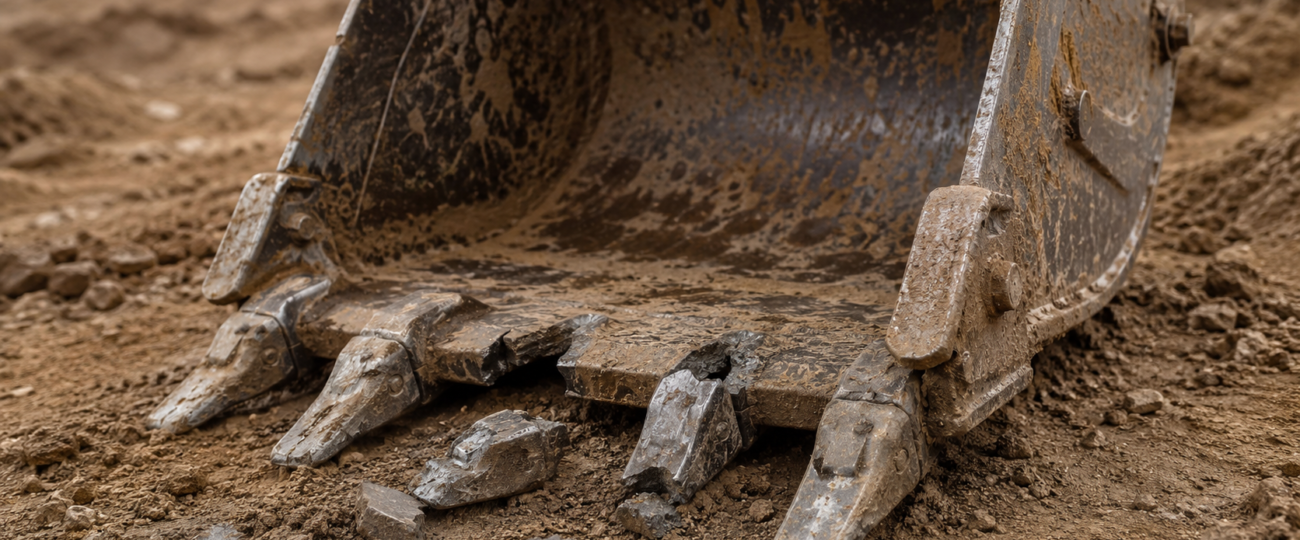

Our bucket teeth keep breaking. Change 1 setting now to stop breakage.
☰ Table of Contents
You replace bucket teeth every week. You lose money. You lose time. You lose patience. Your bucket teeth keep breaking and no one tells you why. If your bucket teeth keep breaking, this post solves that problem entirely.
One single setting causes most tooth breakage. Change this setting today. Your bucket teeth keep breaking issue will stop immediately. Before you dig into the mechanics below, if you’ve also been experiencing performance lag, check out why an excavator swing slow issue is just as easy to fix.
If your bucket teeth keep breaking, you must check this setting: The breaker pressure setting on your hydraulic system. This setting controls how much force your bucket applies to the ground. Too much pressure breaks teeth. Too much pressure shocks the tooth base. Too much pressure snaps the retaining pins.
Most machines come from the factory with high breaker pressure. Factory settings prioritize power over durability. Factory settings assume perfect ground conditions. Factory settings ignore operator technique.
You need to lower your breaker pressure. Lower pressure reduces shock load. Lower pressure extends tooth life. Lower pressure saves money.
Locate the valve: Find the breaker pressure relief valve on your machine. It sits near the main control valve. It looks like a large hex nut with an adjustment screw inside. Your operator manual shows the exact location.
Tools you need: One wrench for the lock nut. One Allen key for the adjustment screw. One pressure gauge with a hose. The gauge connects to the test port near the breaker valve.
Park your machine on level ground. Lower the bucket to the ground. Shut off the engine. Lock out the machine.
Connect the pressure gauge to the test port. Start the engine. Warm the hydraulic oil to operating temperature. Run the machine at 70 percent throttle. Push the bucket curl lever to full stroke. Hold it for 3 seconds. Read the pressure gauge. Record the number.
Compare your reading to the manual specification. Most excavators specify 3500 PSI for breaker pressure. If your reading exceeds specification, your bucket teeth keep breaking from overpressure.
Stop the engine. Lock out the machine. Loosen the lock nut on the breaker relief valve. Turn the adjustment screw counterclockwise. Turn one quarter turn at a time. Start the engine. Test the pressure again. Repeat until your pressure matches the manual specification.
This one change stops the breakage. Your bucket teeth keep breaking nightmare will become a past problem.
Mark operates a 20-ton excavator in a Texas quarry. His bucket teeth keep breaking every 40 hours. He changed brands. He changed sizes. He changed operators. Nothing worked.
I visited his site. I connected a pressure gauge to his breaker valve. The pressure read 4200 PSI. The manual specified 3500 PSI. The machine ran 700 PSI over specification for two years.
I adjusted the valve to 3500 PSI. Mark tested the machine. The digging force felt slightly lower. He did not notice any production drop. Then he waited. 40 hours passed. No breakage. 80 hours passed. No breakage. 120 hours passed. One tooth broke from hitting a buried rock.
Mark called me excited. He asked what changed. I told him the one setting. His bucket teeth keep breaking problem stopped immediately.
When your bucket teeth keep breaking, it drains your yearly budget by thousands. Mark saved 300 dollars per week on tooth replacements. He saved 2 hours per week on change outs. His yearly saving reached 15,000 dollars.
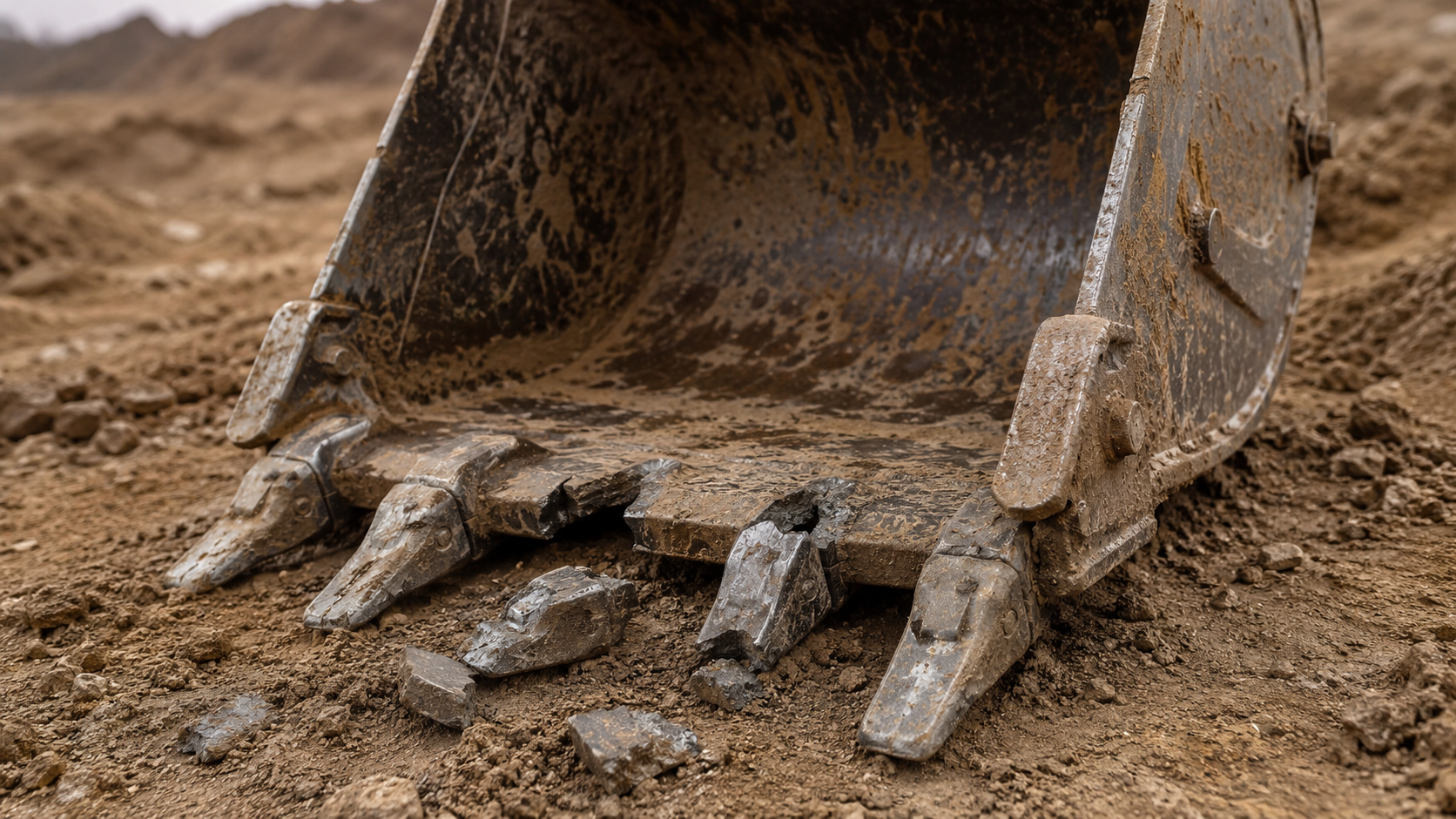
Hydraulic pressure creates force. High pressure creates high force. High force creates high shock. High shock exceeds tooth strength.
Each bucket tooth has a rated breaking force. Most teeth break at 4000 foot-pounds of impact. High breaker pressure delivers 5000 foot-pounds of impact. The tooth fails.
The failure starts as a hairline crack. The crack grows with each impact. The crack reaches the tooth base. The tooth snaps off. The reason your bucket teeth keep breaking follows this exact pattern.
High pressure also damages the retaining pin. The pin holds the tooth to the adapter. High shock deforms the pin. Deformed pins loosen. Loose pins allow tooth movement. Movement causes tooth wear and breakage.
If your bucket teeth keep breaking, lower pressure stops the shock cycle. Lower pressure delivers 3500 foot-pounds of impact. This stays below tooth strength. The tooth flexes without cracking. The pin stays tight. The tooth lasts longer.
A major tooth manufacturer tested breakage rates across different pressures. They used identical teeth on identical machines. The ground condition was uniform.
| Pressure Setting | Average Tooth Life |
|---|---|
| 4200 PSI | 60 hours |
| 3800 PSI | 120 hours |
| 3500 PSI | 200 hours |
The test proves the relationship. Lower pressure directly extends tooth life. Your bucket teeth keep breaking frequency decreases as you reduce pressure.
The manufacturer also tested operator technique. Operators who rammed the bucket into rock broke teeth faster. Operators who curled the bucket gradually broke teeth slower. Operator technique and pressure work together. Change both for maximum tooth life, especially if your bucket teeth keep breaking.
Pressure adjustment fixes most cases. Some cases have other causes. Check these if the adjustment does not work.
- Wrong tooth type. Hard rock requires sharp teeth. Soft ground requires wide teeth. Wrong tooth type causes breakage and ensures your bucket teeth keep breaking. Match your tooth to your ground condition.
- Worn tooth adapter. The adapter holds the tooth. A worn adapter creates movement. Movement causes tooth cracking. Replace worn adapters with the tooth.
- Hard ground with frozen material. Frozen ground acts like concrete. Concrete breaks teeth faster. Reduce your dig speed in frozen conditions. Use a ripper attachment.
- Buried obstacles. Rocks. Rebar. Old concrete. These hidden objects break teeth instantly. Scan your work area before digging.
- Operator rushing. Fast swings create impact forces. Impact forces break teeth. Slow your swing before the bucket enters the ground. Let the bucket engage gradually.
One of these causes affects your machine if your bucket teeth keep breaking. Identify it. Fix it. Stop the breakage.
Prevention beats replacement. Inspect your teeth every morning. Follow these 5 steps:
- Walk around your bucket. Look at each tooth. Look for cracks at the base. Look for missing carbide tips. Look for bent or twisted teeth.
- Grab each tooth with your hand. Try to wiggle it. Movement means a loose retaining pin. Replace the pin before the tooth falls off.
- Check the tooth tip. Worn tips reduce digging efficiency. The machine works harder. Harder work stresses the tooth base. Replace teeth when the tip wears flat.
- Check the adapter nose. A worn nose allows tooth movement. Movement causes breakage. Replace the adapter with the next tooth set.
- Check your hydraulic pressure weekly. Pressure drifts over time. A drifted pressure returns the breakage problem. Adjust back to specification.
This inspection takes 5 minutes. It prevents 80 percent of tooth failures. Your bucket teeth keep breaking problem will stop with consistent inspection.
One broken tooth costs 50 dollars to replace. You might think this is small. The total cost is much larger.
Hidden Damage Costs
- Machine Stop/Downtime (15 mins): $50 lost.
- Damaged Adapter Replacement: $200.
- Damaged Bucket Edge Repair: $2,000.
- Boom Crack Welding: $500 per crack.
- Complete Boom Failure: $5,000.
The Zero Dollar Fix
- Pressure Adjustment: $0 cost.
- Eliminates uneven loading & stress.
- Prevents bucket and boom damage.
- Stops extreme shock loads.
- Saves thousands annually.
The total cost of one broken tooth reaches 300 dollars. If your bucket teeth keep breaking every 40 hours, your monthly cost reaches 1500 dollars. Your yearly cost reaches 18,000 dollars.
One operator ignored the breakage for six months. He spent 9,000 dollars on teeth and repairs. He wondered why his bucket teeth keep breaking, but after adjusting the pressure, the breakage stopped. He saved 9,000 dollars in the next six months. He told me he wasted money for no reason.
Pressure alone does not guarantee tooth life. Your technique doubles the effect. Use these techniques with the pressure adjustment.
- Approach the ground slowly. Do not slam the bucket. Slamming creates impact shock. Lower the bucket with control.
- Curl the bucket as you dig. Curling creates a shearing action. Shearing requires less force. Less force reduces stress.
- Avoid twisting the bucket. Twisting applies side load to the teeth. Teeth are not designed for side load. Keep the bucket aligned.
- Do not pry with the bucket. Prying applies leverage to the teeth. Leverage multiplies force. Use a ripper attachment for prying work.
- Rotate your teeth. Front teeth wear faster than back teeth. Rotate teeth from front to back every 100 hours. Equal wear extends total tooth life.
Combine these techniques with the pressure adjustment, and your bucket teeth keep breaking nightmare will stop completely.
Some machines have a failed relief valve. The valve is stuck open. The valve is stuck closed. The valve internals are worn.
Test the valve response. Connect your pressure gauge. Push the bucket curl lever quickly. Watch the pressure rise. It should rise instantly. Slow rise indicates a worn valve. Replace the valve.
Test for pressure drop. Hold the curl lever at full stroke. Watch the pressure gauge. The pressure should stay constant. Dropping pressure indicates internal leakage. Replace the valve.
Test for pressure spike. Release the curl lever quickly. The pressure should drop instantly. Slow drop indicates a sticking valve. Clean or replace the valve.
A new relief valve costs 300 dollars. Installation takes 30 minutes. This permanent fix restores proper pressure control. Your bucket teeth keep breaking stops after this replacement.
You now know the one setting. You know the adjustment steps. You know the inspection routine. You know the cost of ignoring this problem.
Go to your machine today. Check your breaker pressure. Compare to the manual specification. Adjust down if needed. Start saving money immediately. If your bucket teeth keep breaking, don’t ignore it.
Share your experience in the comments. When your bucket teeth keep breaking, did you try adjusting your breaker pressure? What pressure did you find? How much longer did your teeth last after adjustment? Your story helps other operators.
Looking for compact power with precision hydraulic control? Upgrade your fleet with our premium excavators.
View TYPHON Terror X2 Max 2.7 Ton Mini Excavator →Heavy equipment operations and maintenance powered by TyphonMachinery.com



[…] This post shows you one test. The test finds the water entry point in 5 minutes. You stop the water entry. You save your hydraulic system. You avoid expensive repairs. If you also have trouble digging through tough terrain, read why our bucket teeth keep breaking and how to change 1 setting to stop it. […]