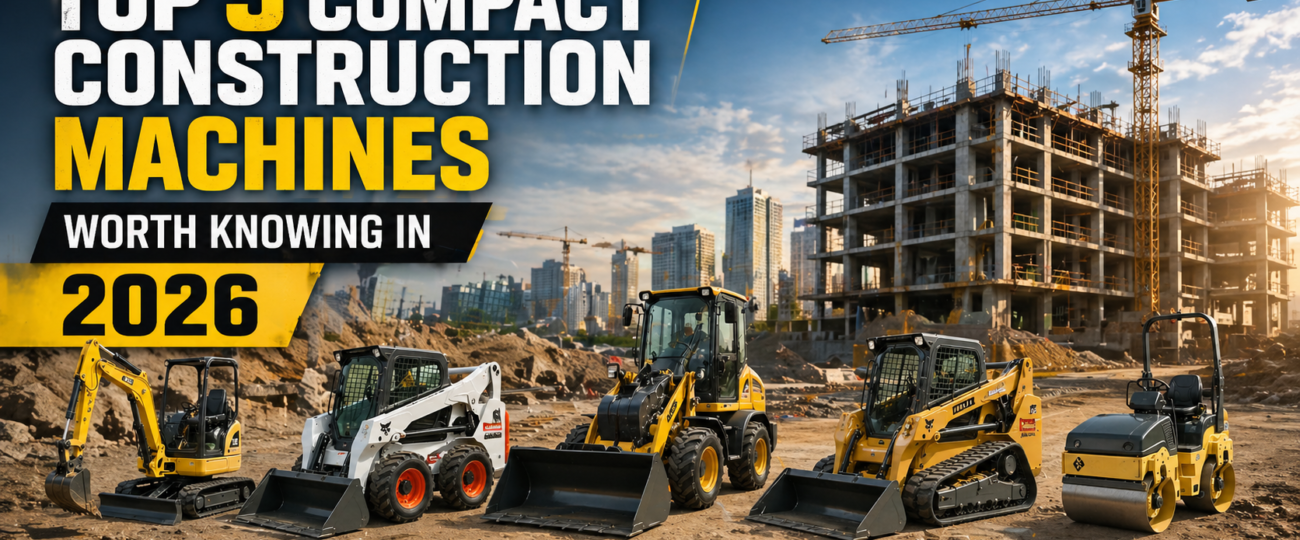

Top 5 Compact Construction Machines Worth Knowing in 2026
Walk any busy job site today and you will notice something. The biggest machine is not always doing the most work. More often, it is the smaller one tucked into a corner, digging around a gas line, or lifting pallets to a second-floor opening, that keeps the project moving.
Compact construction machines have earned their place. Not because they cost less or take up less space, but because certain jobs have no other solution. These five compact construction machines appear on job sites across every continent, every climate, and every type of build. Below is what you need to know about each one in 2026.
A mini excavator is one of the most capable compact construction machines on any job site. Most people picture a full-size excavator when digging comes up. The problem is, full-size machines cannot squeeze between two houses, operate inside a basement, or trench next to a live water main without creating more problems than they solve. That gap is exactly what the mini excavator fills.
Weight ranges from 1 to 10 metric tons. For most day-to-day contractor work, the 2 to 6 ton range covers nearly every situation. Zero tail swing models rotate their counterweight within the machine’s own width, letting operators work in spaces barely wider than a doorway.
Fuel consumption runs 30 to 40 percent lower than full-size excavators per hour. Transport is straightforward. Most models load onto a standard flatbed trailer with no special permits required.
Attachments extend what this machine does. Augers drill post holes. Hydraulic breakers crack concrete. Tilt buckets grade slopes. A single machine with the right attachment handles work that used to need three separate pieces of equipment. Kubota, Bobcat, Caterpillar, and Komatsu are the names you will see most on site.
See a mini excavator built for tight job sites and heavy work:
View the TYPHON TERROR XIX Storm Mini Excavator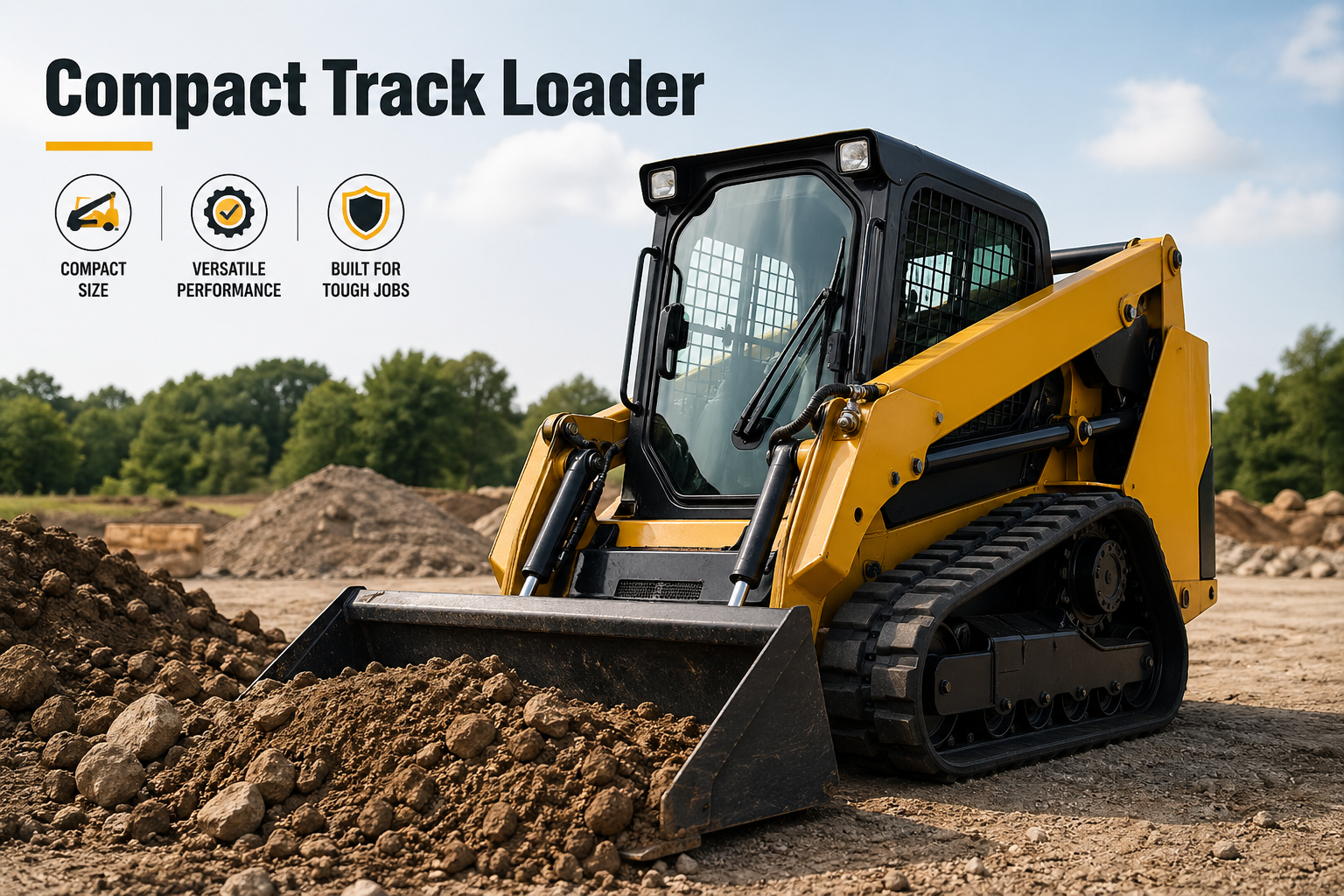
This compact construction machine turns differently from everything else on a job site. Rather than a steering wheel handling direction, it speeds up the wheels on one side while slowing the other. The result is the machine spinning around its own center point. It sounds awkward until you watch one work in a space where nothing else fits.
Bobcat put the first one on a job site in 1960. Sixty-five years later the basic idea has not changed, which tells you something about how well it works. Today Bobcat, John Deere, and Case build the most recognized models worldwide.
What makes the skid steer genuinely useful is the attachment system. Over 1,900 different attachments exist for these machines. Pallet forks, augers, cold planers, concrete mixers, hydraulic breakers, sweepers. One operator, one machine, one quick coupler, and the job changes shape in minutes without anyone leaving the cab.
Rental rates range from $200 to $500 per day globally depending on the model and location. For smaller contractors who cannot justify owning one outright, renting makes more sense financially.
Take a skid steer and replace the wheels with rubber tracks. That single change produces a compact construction machine that behaves completely differently on soft, wet, or unstable ground.
Rubber tracks spread the machine’s weight across a longer contact patch. This reduces ground pressure dramatically. A wheeled machine sinks or spins in mud. A track loader keeps moving.
This matters more than most people realize. Construction schedules do not pause for rain. Coastal projects, river bank work, and post-storm cleanup all happen in conditions where wheeled machines become liabilities. Track loaders keep working.
Operating capacity runs from 700 to over 3,500 lbs depending on the model. In several major markets, compact track loaders now outsell wheeled skid steers because contractors have learned what the machine does in bad conditions. Caterpillar, Takeuchi, and Kubota set the benchmark here.
Speed matters when you are moving bulk material. Skid steers and track loaders are maneuverable, but they are not built for high-cycle material handling. A compact wheel loader is, and that difference shows up in the numbers by end of day.
These compact construction machines articulate at the center rather than skid through turns. That articulation does two things. It lets the machine move faster through loading cycles and it protects finished surfaces from the scuffing that skidding causes.
If your site involves loading trucks, managing aggregate stockpiles, or shifting large volumes of loose material hour after hour, a wheel loader does that work faster and with less wear on the operator.
Smaller models come in under 5 tons. They fit through gates and into spaces that full-size loaders cannot access, while still moving serious volume. Volvo’s L25 Electric is one of the first fully electric compact wheel loaders to reach real commercial scale. Indoor applications like warehouses and underground facilities are pushing demand for electric options where exhaust is not acceptable. JCB and Liebherr also build strong options in this segment.
Related: See how compact machines stack up against full-size equipment on large projects:
Compact vs Full-Size Construction Equipment — 2026A forklift lifts straight up. A crane reaches forward and up. A telehandler does both at once, which is why it replaced two separate machines on a large share of commercial construction sites.
As the boom extends, it moves forward and upward at the same time. That combination lets you drop roofing tiles directly onto a roof deck, position steel from ground level, or get materials over walls and obstacles that stop a standard forklift cold.
Smaller models top out between 19 and 30 feet. They roll through regular site gates and fit into working areas where a crane would need its own crew, its own permits, and half a day of setup.
By 2023 the global market for these compact construction machines crossed $4.5 billion. That figure does not come from one industry. Construction, farming, and heavy industry all run telehandlers now because the machine solves a problem that shows up everywhere. JCB put the first one to work and still holds the top position. Manitou and Merlo follow close behind.
Each of these compact construction machines was built around a specific problem. Here is how they line up:
| Machine | Best Condition | Key Strength | Top Models |
|---|---|---|---|
| Mini Excavator | Tight spaces, indoor sites | Precision digging, low fuel use | Kubota KX057-5, Bobcat E35 |
| Skid Steer Loader | Dry, solid ground | 1,900+ attachments, fast setup | Bobcat S76, John Deere 332G |
| Compact Track Loader | Wet, soft, unstable ground | Low ground pressure, all-weather | Cat 299D3 XE, Takeuchi TL12V2 |
| Compact Wheel Loader | High-cycle material handling | Speed, surface protection | Volvo L25 Electric, JCB 407 |
| Telescopic Handler | Vertical reach required | Lifts up and forward simultaneously | JCB 531-70, Manitou MT 625 |
None of these compact construction machines competes with the others. Each one was built around a specific problem on specific ground.
Tight space with digging involved — go with the mini excavator.
Fast and adaptable on dry solid ground — the skid steer fits.
Ground turns wet or soft — the track loader keeps working when everything else gets stuck.
Moving bulk material hour after hour — the wheel loader does it faster.
Work goes vertical — the telehandler takes over.
Plenty of contractors keep two or three of these running on the same site at once. The excavator cuts the ground open. The track loader moves what comes out. The telehandler drops supplies in place for whoever is working the next phase.
Before signing anything, walk your site first. Check the access points, understand what the ground does after rain, make sure your attachments fit the machine you are renting, and match the machine weight to what your trailer can legally carry.
The right compact construction machine in the right place does not just speed things up. It changes how the whole site operates.
Looking for a proven compact construction machine built for real job site conditions? The TYPHON TERROR XIX Storm is a 4,000 lb mini excavator with boom swing, retractable tracks, and a canopy — ready for the tightest sites and the toughest ground.
See the TYPHON TERROR XIX Storm →

[…] stand on a platform. Stand on skid steer drive with two levers. You see in every direction around the machine.A stand on skid steer weighs […]