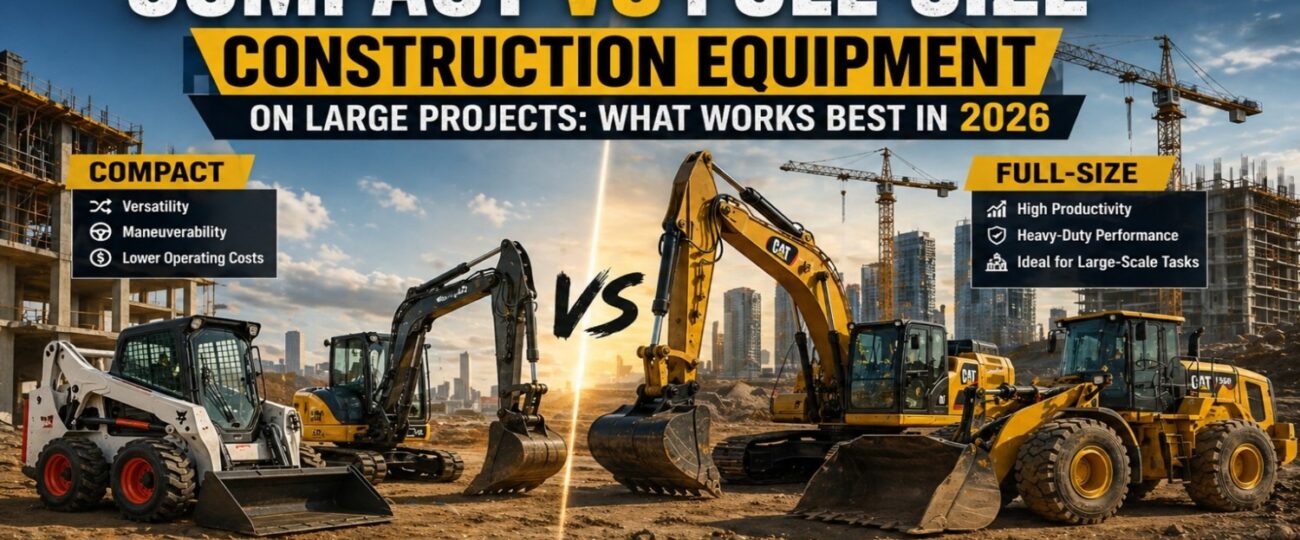

Compact vs Full-Size Construction Equipment on Large Projects: What Works Best in 2026
Large projects do not always need large machines. That assumption costs contractors time and money every year. The real question is not which machine is bigger. The question is which machine fits the work in front of you.
This guide breaks down the compact vs full-size construction equipment debate — where compact holds its own on large-scale projects, where full-size wins without argument, and how experienced contractors mix both to get the job done faster and cheaper.
Most project managers default to full-size equipment on large jobs. Bigger site, bigger machine. The logic feels right but it breaks down quickly when you look at how large projects actually run.
Large construction sites are not one big open area. They are collections of smaller work zones operating at the same time. A high-rise project runs foundation work, underground utility installation, material staging, and interior demolition simultaneously. Full-size machines serve some of those zones well. They serve others poorly or not at all.
This is where the compact vs full-size construction equipment question becomes genuinely important. Compact equipment fills the gaps. It works in zones where full-size machines create access problems, safety risks, or surface damage that costs more to fix than the job is worth.
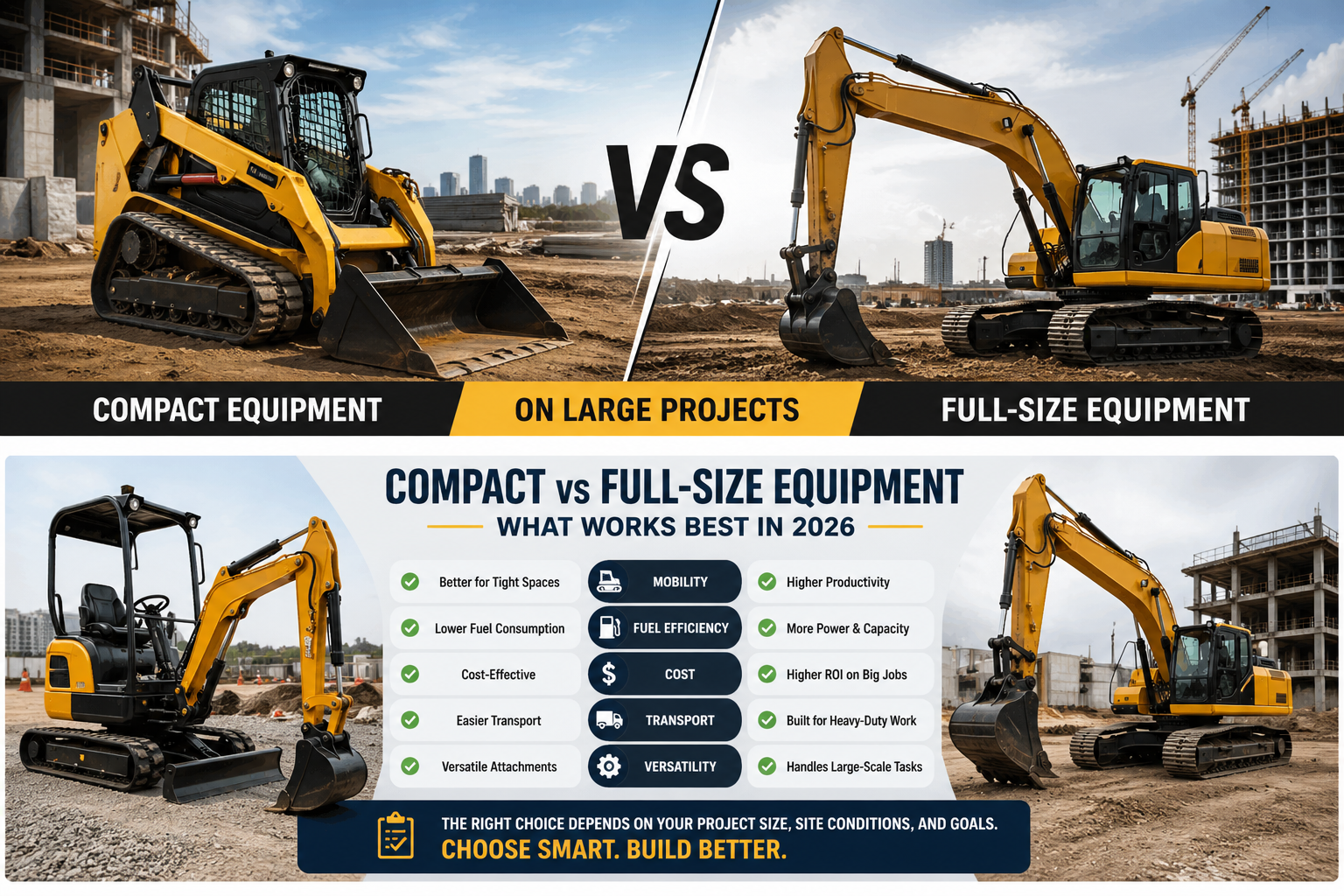
Full-size machines exist for a reason. On the right task, nothing replaces them. Understanding where full-size wins is just as important as knowing where compact equipment excels — that is the honest starting point for any compact vs full-size construction equipment decision.
Mass excavation is the clearest example. When you need to move 50,000 cubic yards of earth on a timeline, a fleet of large excavators and articulated dump trucks does that work. A mini excavator fleet comes nowhere near the same output per hour.
Bulk material movement across open ground favors large wheel loaders. A Caterpillar 980 or Komatsu WA470 moves more per cycle and covers ground faster than any compact loader. Large cranes handle lifts that no telehandler touches — structural steel on a 20-story building, precast panels on a bridge deck, tower units on a wind farm. These lifts require machines rated in tons, not pounds.
Bottom line: If your project involves open terrain, long distances, and high-volume single-task work, full-size equipment earns its place without question.
Experienced contractors know something that gets overlooked in equipment planning meetings. In the compact vs full-size construction equipment debate, large projects create tight spaces as they progress — and that changes everything.
A site that looks open in week one looks completely different in week eight. Foundations go in. Formwork goes up. Underground utilities get installed. Temporary structures appear. By mid-project, the site has corridors, obstacles, and restricted zones everywhere. That is when compact equipment becomes the productive choice, not the fallback option.
Mini excavators work inside partially built structures. They dig alongside existing utilities without the clearance problems a full-size machine creates. On infrastructure projects, mini excavators regularly outperform full-size equipment on utility installation because they access areas full-size machines physically cannot reach.
Compact track loaders move material inside structures, across finished concrete, and through access points that standard loaders damage or cannot enter. Ground pressure from rubber tracks protects surface finishes that full-size wheeled equipment destroys. Telehandlers on large commercial projects handle floor-by-floor material distribution — freeing the crane for structural lifts only.
Related: Skid Steer vs Compact Track Loader — which compact machine should you buy first?
Skid Steer vs Compact Track Loader — Full BreakdownEquipment decisions often focus on machine specs rather than actual site productivity. That approach misses the point of the entire compact vs full-size construction equipment discussion.
A full-size excavator sitting idle because it cannot access a work area delivers zero output. A mini excavator working constantly in that same zone outperforms the full-size machine in practical output for that specific job. The spec sheet does not reflect that. The timesheet does.
Fuel costs favor compact equipment, especially on jobs where full-size machines are oversized for the task. A mini excavator running 8 hours on a utility trench burns a fraction of the fuel a full-size excavator burns doing the same work. On a 12-month project, that difference adds up to a number worth calculating before you order equipment.
Mobilization costs also favor compact equipment. Moving a full-size excavator between zones or off site requires lowboys, permits, and planning time. A compact machine loads on a standard trailer and moves in an hour.
Compact Equipment Advantages
- Works where full-size cannot access
- 30–40% lower fuel burn on matched tasks
- Standard trailer — no permits needed
- Lower day rate and rental cost
- Continuous output in congested zones
Full-Size Equipment Advantages
- Higher output on open-site bulk tasks
- Handles heavy structural lifts
- Faster cycle times on mass earthworks
- More attachment capacity for heavy work
- Better suited for long-distance material runs
This is where the compact vs full-size construction equipment judgment gets serious for project managers watching the budget.
Full-size equipment on tight sites causes damage. Underground utilities get hit. Finished surfaces get torn up. Existing structures get clipped. Each incident creates rework costs, schedule delays, and possible penalties that wipe out any productivity advantage the larger machine had.
Compact equipment reduces that risk on congested sites. The machine fits the space. The operator has full visibility. The ground pressure stays within acceptable limits for the surface below.
On projects with existing structures nearby, underground services running beneath the work zone, or surface finishes worth protecting, compact equipment pays for itself in avoided damage alone. That calculation rarely appears in equipment planning spreadsheets — but it should.
The contractors who finish large projects on time and on budget do not choose between compact and full-size. They plan for both from the start. Understanding compact vs full-size construction equipment is not about picking a side — it is about knowing when each machine earns its place.
A standard approach on large commercial builds looks like this:
- Early stage — site open, access unrestricted: Full-size excavators handle bulk earthworks at maximum output.
- Mid-project — site gets congested: Compact equipment takes over for detail work, utility installation, and interior logistics.
- Throughout the project: Telehandlers run material distribution floor by floor, freeing the crane for structural lifts only.
- Finished areas and tight zones: Compact track loaders handle site cleanup and material movement where large equipment causes surface damage.
This approach keeps every machine working at the task it does best. No machine sits idle because it cannot access the work. No site gets damaged because the wrong equipment forced its way into a tight zone.
Looking for a compact machine built for large project conditions?
See the TYPHON STOMP X1300 Mini Skid SteerHere is how the two categories compare across the factors that matter most on large projects:
| Factor | Compact Equipment | Full-Size Equipment | Winner |
|---|---|---|---|
| Tight access zones | Works inside structures, narrow corridors | Cannot access — creates clearance problems | Compact |
| Mass excavation | Slower output per hour | Purpose-built for bulk earthworks | Full-Size |
| Fuel cost per task | 30–40% lower on matched jobs | Higher burn rate, especially when oversized | Compact |
| Mobilization | Standard trailer, no permits | Lowboy, oversize permits, lead time | Compact |
| Heavy structural lifts | Telehandler range only | Crane-class capacity | Full-Size |
| Surface damage risk | Low — rubber tracks, low ground pressure | High on finished or congested sites | Compact |
| Material distribution (floors) | Telehandler works continuously | Crane tied up on pallet drops | Compact |
Before you finalize your compact vs full-size construction equipment mix for a large project, work through these four points. Skipping any one of them leads to equipment on site that either cannot access the work or costs more per hour than the task justifies.
- Map your site in phases, not just day one. The access conditions in month six look nothing like month one. Equipment that works in the early phase creates problems later if you have not planned for the transition.
- Identify your restricted zones early. Underground utilities, existing structures, finished surfaces, and tight access corridors all point toward compact equipment regardless of overall project size.
- Calculate total cost, not day rate. Fuel, mobilization, damage risk, and idle time all factor into which machine costs less over the full project duration. The lower day rate is not always the lower total cost.
- Talk to your operators. They know which machine fits which zone from direct experience. Equipment planning that ignores operator input misses the most practical knowledge available on any site.
Large projects need the right machine for each task — not the largest machine for every task. The contractors who understand that difference in the compact vs full-size construction equipment decision consistently outperform those who do not.
Ready to add a compact machine that earns its place on large projects? The TYPHON STOMP X1300 is a 25HP Kubota diesel mini skid steer built for the kind of congested, detail-work conditions where full-size equipment falls short. One machine. Real output where it counts.
See the TYPHON STOMP X1300 →

[…] Every Contractor Should Know 2026Skid Steer vs Compact Track Loader: Which One Should You Buy First?Compact vs Full-Size Construction Equipment on Large Projects: What Works Best in 2026Top 5 Compact Construction Machines Worth Knowing in […]
[…] Grading soil with a rake takes practice. A land leveler on your mini skid steer creates a smooth finish. Prepare a yard for sod. Level a gravel driveway. Finish a patio base.The leveler uses a flat bar and a rear roller. Your mini skid steer pushes the leveler across the soil. High spots get cut down. Low spots get filled. One pass flattens the surface.A 48-inch leveler works well on a mini skid steer. Wider levelers cause the machine to tip on uneven ground. Take shallow cuts. Make multiple passes.How to Choose Your First Three Attachments […]